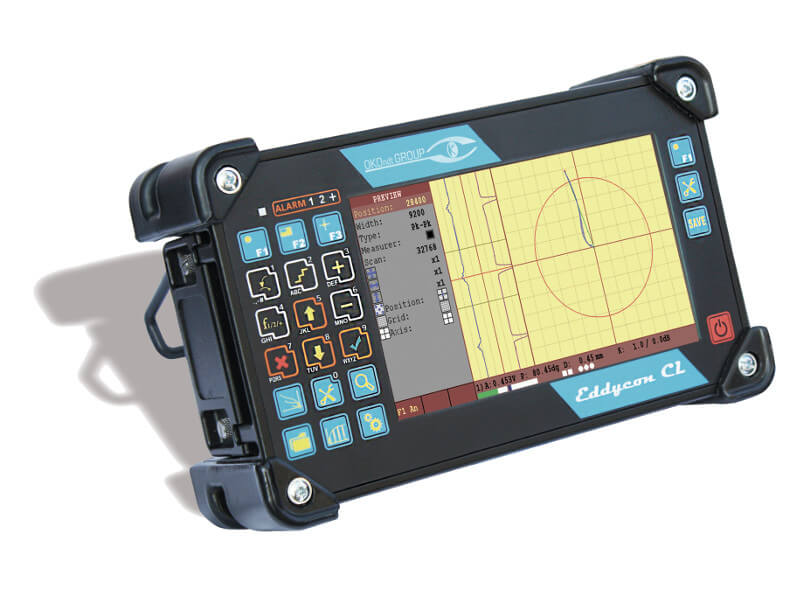
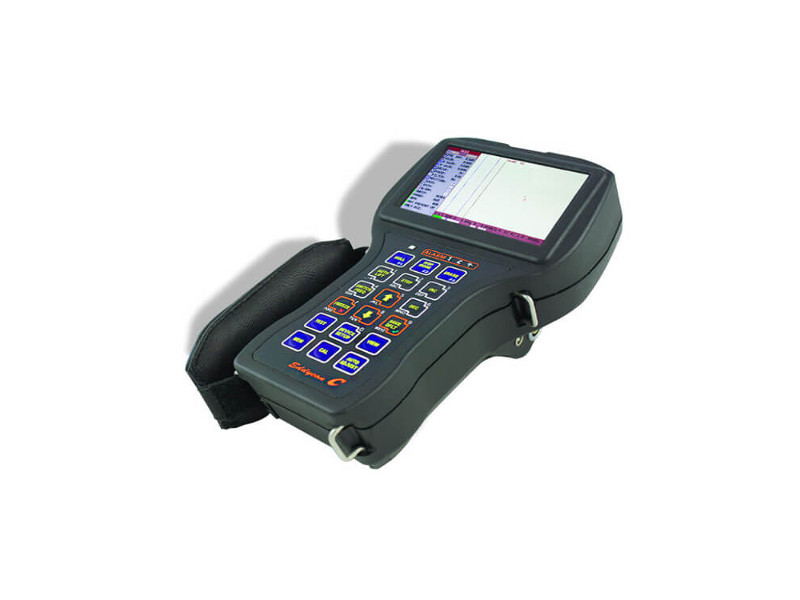
Key Applications of Eddy Current Flaw Detectors
Detection of Cracks in Conductive Materials
Portable eddy current flaw detectors are used to detect surface and subsurface cracks and discontinuities in conductive materials that are at least 0.002 in (0.05 mm) deep and at least 7.87 × 10⁻⁵ in (0.002 mm) wide. These devices are widely used to detect cracks in metal sheets and tubing in manufacturing and service environments, including inspections of multi-layered components where defects may be present in internal layers beneath the surface. They also confirm the results of railroad inspections performed by high-speed rail testing systems across the rail sector. In the aerospace sector, portable eddy current detectors are used to inspect aircraft fuselage skins, engine turbine blades, and other critical airplane and helicopter components. They support the early detection of cracks in high-stress areas and fastener zones, ensuring the timely replacement of components and increasing the airworthiness of aircraft.
Detection of Cracks in Bolt, Countersunk, and Rivet Holes
Crack detection in various types of fastener holes is often performed during an eddy current inspection of aircraft wheels and airframe skins. This process is carried out with a portable flaw detector and specialized eddy current testing probes. The inspection can be performed with or without a rotating bolthole scanner using dynamic eddy current probe types such as bolt hole, rigid, and countersink probes. Such testing kits are widely used in aviation maintenance, repair, and overhaul (MRO) for NDT of aeronautical components, supporting acceptance decisions and audits.
Detection of Cracks in Welded Joints and Heat-Affected Zones
Handheld eddy current flaw detectors are widely used for testing weld joints, enabling detection of surface cracks in weld joints and heat-affected zones. When used in combination with ultrasonic flaw detectors, the eddy current flaw detectors support comprehensive inspection of welds at full depth and length. This approach is applied in NDT of welded steel structures, bridge structures, oil and gas offshore platforms, and product pipelines inspected under paint-and-lacquer or insulation coatings.
Based on weld geometry, accessibility, and joint parameters, the eddy current flaw detectors are equipped with probes selected by working face diameter and configuration, including straight or L-shaped probes.
Evaluation of Electrical Conductivity in Non-Magnetic Materials
Portable eddy current detectors can also be used to evaluate the electrical conductivity of metals in applications where material properties are critical. Conductivity measurement supports material verification and alloy sorting by identifying differences in metal composition, heat treatment condition, and material state. This capability is widely applied in quality control and manufacturing inspection of conductive materials. For these purposes, the flaw detector is used in combination with a dedicated conductivity probe.
Measurement of Nonconductive Coating Thickness
Eddy current detectors are used to measure the thickness of nonconductive coatings, such as paint or lacquer, when applied over conductive substrates. Typical applications include measuring the thickness of paint on airframe components, inspecting the coatings on industrial pipelines, and inspecting wire insulation during manufacturing. Controlling coating thickness helps ensure that protective layers are applied within specified limits, which supports corrosion protection and the long-term durability of aircraft components. For these applications, a surface absolute pencil probe is used with a portable eddy current tester.
Sales & Partnership Proposals
OKOndt GROUP is a manufacturer of portable eddy current testing equipment. We offer standard NDT products and customized solutions for a wide range of nondestructive testing applications. Our team helps customers select suitable portable instruments, eddy current probes, and calibration blocks tailored to their specific inspection needs. We also provide pricing information, delivery options, and technical consultations to help customers make informed purchasing decisions. To receive detailed product information or a commercial proposal, please complete the contact form on our website.